roofline
Half round, ogee or square guttering, which should you choose?
Published 24 September 2026 by Dawn Radford
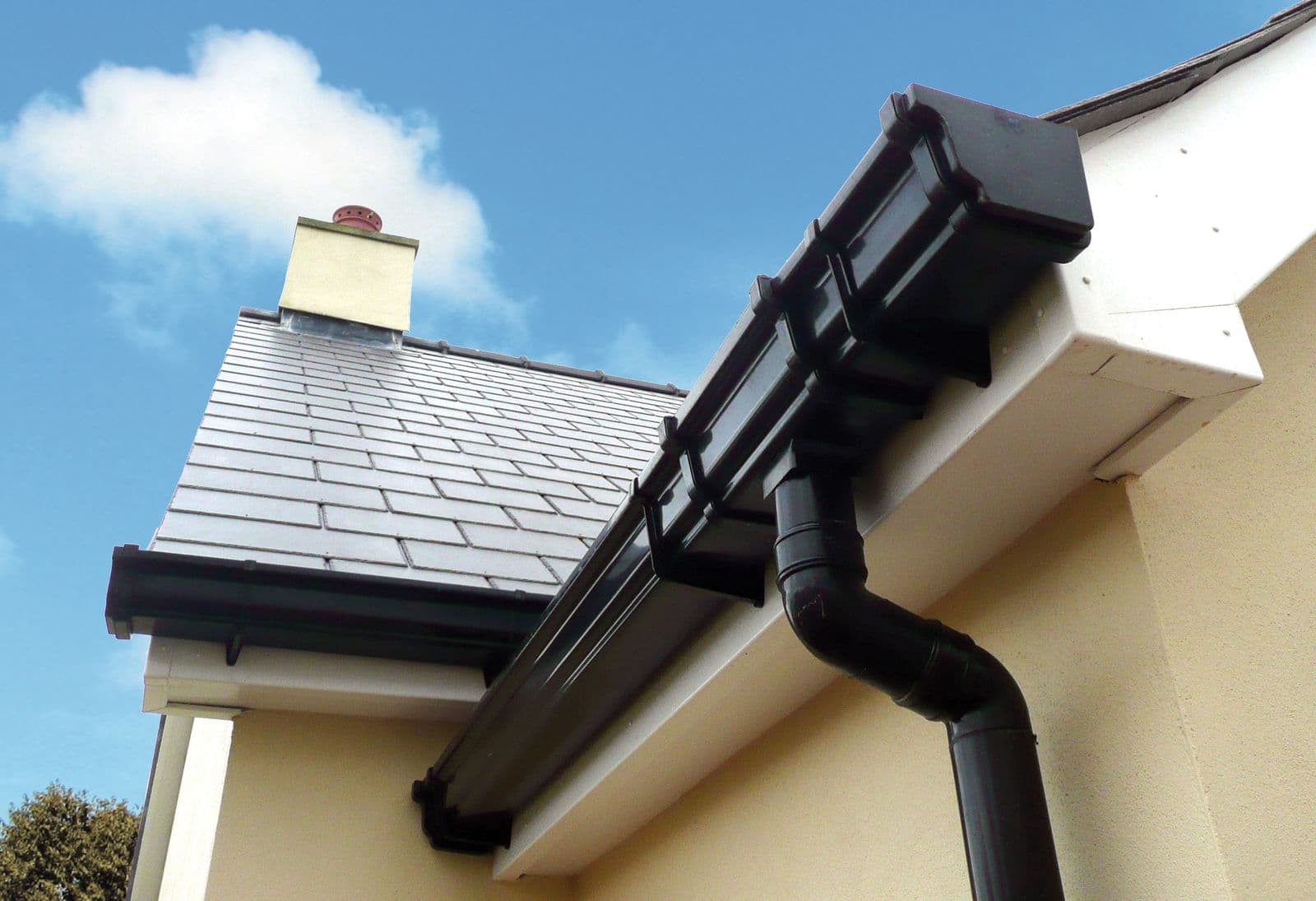
There are three gutter profiles most houses choose between, and the decision comes down to two things, how much water the roof sends into them and what suits the look of the property. Half round is the traditional semicircular profile, the simplest and the easiest to keep clear. Ogee has a decorative moulded front face, sits flat against the fascia and generally carries more water for the same nominal size. Square is the flat sided modern profile, with good capacity and a clean straight line.
For most ordinary houses any of the three will physically cope, so appearance ends up leading the choice. Where capacity genuinely decides it is on larger roof areas, steeply pitched roofs that shed water fast, and long runs that have to reach a single outlet. Below is how to tell which situation you are in.
Half round, the traditional default
Half round is exactly what it sounds like, a semicircle, held on brackets fixed to the fascia. It is the most common profile on British housing, the least expensive, and the one most people picture when they think of guttering.
Its real practical advantage is that it is the easiest of the three to clear out. There are no internal corners for silt and leaves to pack into, and a gloved hand or a scoop clears a run quickly. On this coast that matters more than it does inland, because gutters here fill with windblown sand and salt deposits considerably faster than most people expect, and anything that makes clearing them quicker gets done more often.
It suits almost any property and is rarely a wrong answer. Where it falls short is capacity on a big or steep roof, and looks on an older frontage that originally had cast iron.
Ogee, for houses that had cast iron
Ogee has a shaped front face with a moulded profile, and a flat back that sits tight against the fascia board rather than standing off it on brackets. That shape is not decoration for its own sake. It is a modern reproduction of the cast iron guttering that was standard on Victorian and Edwardian houses, which is why it looks right on them and half round can look slightly bare.
It also holds more water than a half round gutter of the same nominal size, because the profile is deeper and squarer in section. On a period house with a decent roof area, that combination of the right appearance and more capacity is genuinely useful.
In our experience, ogee works better than half round on the older frontages around here because it holds more water for the same nominal size while looking like what the house originally had, and its flat back sits tight to the fascia, which gives windblown debris one less gap to lodge in on a coast where gutters silt up quickly. It costs a little more and on a period property it is usually worth it.
Square, for a modern frontage
Square guttering has flat sides and a flat base, giving a crisp straight line along the eaves. It suits newer houses, contemporary extensions and anything where the roofline is meant to read as simple and geometric.
Capacity is good, better than half round of the same nominal size. The trade-off is the one you would expect from the shape. Internal corners collect silt more readily than a curved base does, so a square run wants clearing a little more diligently, and on a plot with overhanging trees or heavy windblown sand that is a real consideration rather than a theoretical one.
Capacity, and when it actually matters
Most homeowners never need to think about gutter capacity, and then some do. The things that push a roof towards needing more than a standard half round run are a large roof area feeding one gutter, a steep pitch, which delivers water to the gutter faster rather than letting it soak and trickle, a long run with only one outlet at the end, and a valley or a secondary roof discharging into the same gutter.
The symptom of being under capacity is water going over the front edge in heavy rain rather than leaking from a joint. If your gutter overflows along its length during a downpour and the joints are sound, the problem is size or fall or outlet position, not a defect.
Two other things are worth more than the profile itself. The fall, meaning the slight slope along the run towards the outlet, has to be right or water stands and silt settles wherever it stops. And the number and position of downpipes matters as much as the gutter, because a long run trying to drain through one outlet at one end will struggle whatever shape it is.
Colour, and matching what is already there
All three profiles come in a range of colours, most commonly white, black, brown and anthracite. Black is the natural choice where you are replicating cast iron on an older property. White is the most common and the least conspicuous on a white roofline. Anthracite has become popular alongside anthracite windows and works well on modern frontages.
The thing to check is what the rest of the roofline is doing, because gutter, fascia, soffit and any cladding read as one band across the top of the house. Changing one of them in isolation is how a frontage ends up looking mismatched from the pavement even though every individual part is new.
Do it with the boards, not after them
This is the practical point that saves the most money. The gutter has to come off for fascias and soffits to be replaced, the old brackets rarely line up cleanly with a new fascia, and a tired gutter is usually what caused the damage to the boards in the first place. Putting the old guttering back onto new boards is a false economy that shows up within a couple of winters.
If your boards are already showing signs the fascias and soffits need replacing, that is the moment to change the guttering too, and to decide the profile properly rather than defaulting to whatever came off. We fit all three profiles as part of our fascias and soffits work, so the choice is a genuine one rather than whatever is on the van.
Where a run has a leaking joint, a sagging section or a blocked outlet rather than a whole house problem, that is a repair rather than a replacement, and our repairs service covers it, including on installations somebody else fitted.
Keeping them clear on this coast
Whichever profile you end up with, the maintenance point is the same and it matters more here than most places. Windblown sand, salt and leaf debris fill gutters along this coast quickly, and a full gutter is heavy, which is what pulls brackets out of softening timber and starts the whole cycle again. Twice a year is a sensible rhythm, autumn and spring, which is the same cadence that keeps coastal weather from wearing out your windows.
The short version
Half round for value, simplicity and the easiest clearing. Ogee for period frontages and where you want more capacity with a traditional look. Square for modern houses and clean lines. Check the fall and the downpipe positions, because they matter as much as the profile. Replace the guttering at the same time as the boards, and clear it twice a year.
If you would like somebody to look at your roofline and tell you what it actually needs, Piper Windows has been fitting roofline across this coast since 1983. Get a free no-obligation quote or ring us on 01754 898 998.
Thinking about new windows, doors or a conservatory? Request a free no obligation quote or call us on 01754 898 998.